The Anker SOLIX C1000 Gen 2 and the BLUETTI AC180 are two of the most popular power stations in the 1kWh class: big enough to keep a fridge, router and CPAP going through a night-long outage, small enough to carry to a campsite. On paper they look similar. In practice they're built for slightly different buyers.
We compared them spec by spec using each manufacturer's official data. Below you'll find the full comparison table, real runtime math and a clear recommendation for each type of buyer.
The short answer
Buy the Anker SOLIX C1000 Gen 2 if you want the fastest wall recharge in its class, a lighter box (24.9 lb vs 35.3 lb), more USB-C power and a ≤10 ms UPS switchover that suits computers and network gear.
Buy the BLUETTI AC180 if you want the most capacity for the money, more USB-A ports plus a wireless charging pad, and the option to add BLUETTI's external batteries later through its DC input.
Specs side by side
Every value below comes from the manufacturers' published spec sheets. A dash means the brand doesn't publish that figure.
| Spec | Anker SOLIX C1000 Gen 2 | BLUETTI AC180 |
|---|---|---|
| Capacity | 1,024 Wh | 1,152 Wh |
| Battery chemistry | LiFePO4 | LiFePO4 |
| Rated cycle life | 4,000 cycles | 3,500 cycles |
| AC output (continuous) | 2,000 W | 1,800 W |
| Surge / peak | 3,000 W | 2,700 W |
| AC outlets (120V, pure sine) | 5 | 4 |
| Max USB-C output | 140 W | 100 W |
| Max AC charging input | 1,600 W | 1,440 W |
| Fastest full charge | 49 min | 78 min |
| Max solar input | 600 W | 500 W |
| Weight | 24.9 lb (11.3 kg) | 35.3 lb (16 kg) |
| UPS switchover | ≤10 ms | ≤20 ms |
| Expandable battery | No | — |
| Warranty | 5 years | 5 years |
| Amazon | Check Price | Check Price |
Specs from each manufacturer's official spec sheet, as listed in our reviews. Highlighted = better on paper.
Capacity and real-world runtime
The BLUETTI AC180 holds 1,152 Wh, about 12% more than the Anker's 1,024 Wh. That gap matters most on long, steady loads.
We estimate runtime as capacity × 85% ÷ device watts; the 85% accounts for typical inverter losses on AC loads. For a CPAP drawing 40 W (without the humidifier):
- Anker C1000 Gen 2: 1,024 Wh × 85% ÷ 40 W ≈ 22 hours
- BLUETTI AC180: 1,152 Wh × 85% ÷ 40 W ≈ 24 hours
For a refrigerator averaging 150 W over a day (a conservative figure; many modern fridges average less):
- Anker C1000 Gen 2: 1,024 Wh × 85% ÷ 150 W ≈ 5.8 hours
- BLUETTI AC180: 1,152 Wh × 85% ÷ 150 W ≈ 6.5 hours
Both will carry a fridge through a typical overnight outage. If you want to work out the number for your own fridge, see How Long Will a Power Station Run a Refrigerator? (The 3-Step Math).
Power output: what each one can run
The Anker's inverter is rated 2,000 W continuous (3,000 W surge), against 1,800 W (2,700 W surge) for the BLUETTI. Both handle most kitchen appliances, power tools and space heaters on their low setting, but the Anker has more headroom if you run several things at once.
The BLUETTI adds Power Lifting: BLUETTI says it can run resistive heating devices rated up to 2,700 W, such as kettles, hair dryers and heaters. It's useful, but it only applies to heating-type loads, not to motors or electronics.
Outlet count: the Anker has 5 AC outlets and 3 USB-C ports (up to 140 W each on the two main ones). The BLUETTI has 4 AC outlets, 1 USB-C port at 100 W, 4 USB-A ports and a 15 W wireless pad. If you charge laptops, the Anker's 140 W USB-C ports are the better fit.
Charging speed: wall and solar
This is where the Anker pulls ahead. With UltraFast Charging switched on in the Anker app, it goes from 0 to 100% in 49 min from a wall outlet. Anker notes it reaches full speed only when the battery is above 68°F. The BLUETTI's Turbo Charging takes 78 min at best (BLUETTI quotes 1.3–1.8 hours).
On solar, the Anker accepts up to 600 W and the BLUETTI up to 500 W. Anker's published full solar recharge is 1.8 hr; BLUETTI quotes 2.8–3.3 hours at its maximum input. Both figures assume ideal sun, so expect longer in real conditions.
Fast recharging matters most during rolling blackouts: if power comes back for an hour, the Anker can be full again before the next cut.
Portability and build
The Anker weighs 24.9 lb and measures 15.12 × 8.19 × 9.61 in. The BLUETTI weighs 35.3 lb and measures 13.4 × 9.7 × 12.5 in. That roughly 10 lb difference is noticeable if you carry it to a campsite or up and down stairs.
Both use LiFePO4 cells, the long-lasting, thermally stable chemistry we recommend. Anker rates its battery for 4,000 cycles and BLUETTI for 3,500 cycles, both to 80% capacity. Both come with a 5 years warranty.
UPS backup and expansion
Both can act as an uninterruptible power supply (UPS): plugged into the wall, they pass power through and switch to battery when the grid drops. The Anker switches in ≤10 ms, the BLUETTI in ≤20 ms. For desktop computers and network equipment, the faster switchover is the safer choice.
Neither has a dedicated expansion port. Anker dropped expansion on the Gen 2 to make it smaller and lighter. BLUETTI says its B80, B230 and B300 batteries can recharge the AC180 through its DC input, for up to 4,224 Wh combined.
Real-world scenarios
Working from home through an outage
A laptop drawing about 60 W plus a modem and router drawing about 15 W adds up to roughly 75 W. That's about 12 hours on the Anker and about 13 hours on the BLUETTI, a full workday with plenty to spare on either. Here the Anker's faster UPS switchover and USB-C ports tip the balance: plug the router into it and the connection won't drop when the grid does.
A weekend of camping
Say you run a 12V compressor cooler averaging 35 W, plus lights and phones. On AC power that cooler alone would run for about 25 hours on the Anker and about 28 hours on the BLUETTI. Running it from the 12V car outlet avoids inverter losses, so real runtime is usually a little longer than these AC-based figures. Here, carrying weight matters: the Anker is the one you'll want to lift in and out of the car.
Rolling blackouts
When the grid comes back for short windows between cuts, recharge speed beats capacity. The Anker can refill in 49 min, so a one-hour window is often enough to start the next outage nearly full. The BLUETTI needs 78 min at best.
Kettle, hair dryer or heater
For heating-type appliances the BLUETTI's Power Lifting mode is the deciding feature. Just remember that heaters drain any 1kWh battery quickly, so treat them as short, occasional loads.
Things to know before you buy
- UltraFast Charging is switched on in the Anker app. Out of the box the Anker charges at its standard rate; you enable the 49-minute mode in the app.
- Don't confuse the AC180 with the AC180P. The AC180P is a different model with 1,440Wh. This comparison covers the AC180, which has 1,152 Wh.
- Check the AC180's weight figure. BLUETTI lists 35.3 lb in its spec table, but another section of its page says 37 lb. Either way, it's the heavier of the two.
- The Gen 2 is not the original C1000. The first-generation Anker SOLIX C1000 could take an expansion battery; the Gen 2 can't. Make sure the listing you buy says Gen 2.
Price and value
At the brands' own US store prices when we checked, the Anker listed at $699.99 and the BLUETTI at $499.00. That works out to 1.46 Wh/$ for the Anker and 2.31 Wh/$ for the BLUETTI. Amazon prices change often and are frequently lower during sales, so check the current price before you decide.
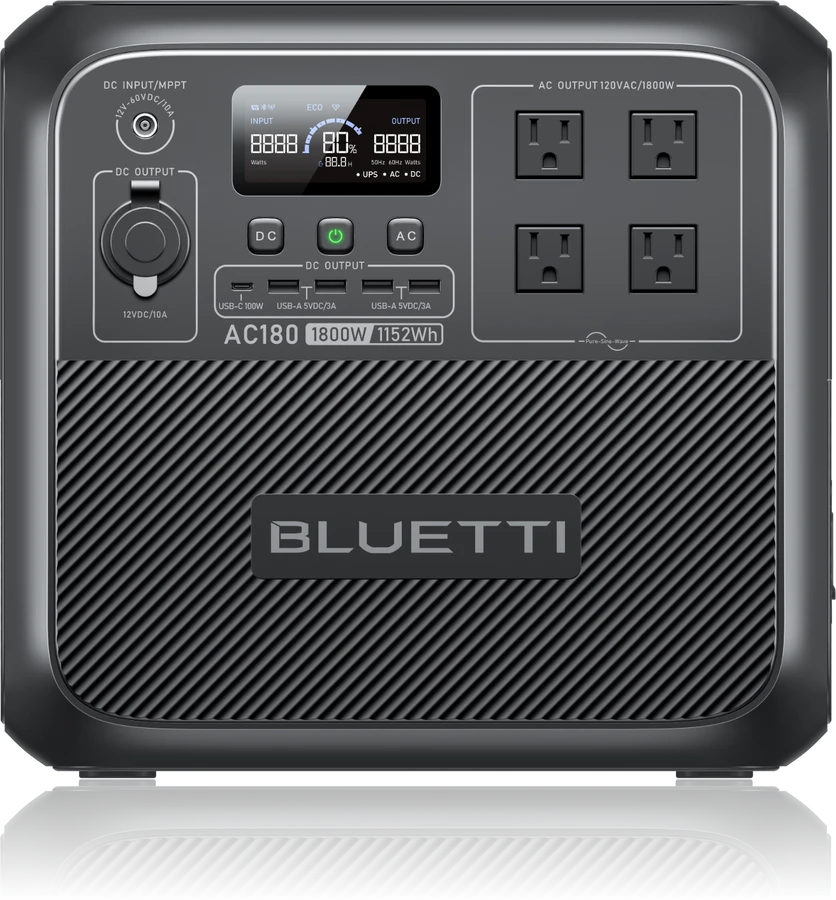
BLUETTI
BLUETTI AC180
Which one should you buy?
Choose the Anker SOLIX C1000 Gen 2 if…
- You live with frequent or rolling outages and need to recharge fast.
- You'll protect a computer, modem or router (≤10 ms UPS).
- You'll move it often and want the lighter unit.
- You charge laptops over USB-C.
Choose the BLUETTI AC180 if…
- You want the most capacity for your budget.
- You run heating-type appliances and want Power Lifting.
- You have lots of USB-A devices, or like the wireless pad.
- You may add an external battery later.
Frequently asked questions
Which has more capacity, the Anker C1000 Gen 2 or the BLUETTI AC180?
The BLUETTI AC180 has more: 1,152 Wh against 1,024 Wh for the Anker SOLIX C1000 Gen 2.
Which charges faster?
The Anker. With UltraFast Charging it goes from 0 to 100% in 49 min from the wall (battery above 68°F). The BLUETTI AC180 needs 78 min at best.
Can either one run a full-size refrigerator?
Yes. Both inverters are well above what a household fridge draws while running. Using a conservative 150 W daily average, the Anker runs one for about 5.8 hours and the BLUETTI for about 6.5 hours.
Can I add an extra battery?
Not to the Anker SOLIX C1000 Gen 2, which has no expansion port. BLUETTI says its B80, B230 and B300 batteries can recharge the AC180 through its DC input.
Products in this article
Anker
Anker SOLIX C1000 Gen 2
The fastest-charging 1kWh station, with a 2,000W inverter
- 1,024 WhCapacity
- 2,000 WAC output
- LiFePO4Battery
- 24.9 lbWeight
$699.99reference price*
BLUETTI
BLUETTI AC180
A proven 1.1kWh all-rounder at a mid-range price
- 1,152 WhCapacity
- 1,800 WAC output
- LiFePO4Battery
- 35.3 lbWeight
$499.00reference price*
Sources
- Anker SOLIX C1000 Gen 2: official product page and specs
- BLUETTI AC180: official product page and specs
Product specs come from each manufacturer's official spec sheet, linked on our review pages. Runtime estimates use our published method: capacity × 85% ÷ device watts (how we calculate).
Keep reading
 How-to · Nov 13, 2026
How Long Will a Power Station Run a Refrigerator? (The 3-Step Math)
How long will a power station run a refrigerator? Find your fridge's real watts on its EnergyGuide label, then do the 3-step math. Runtime table included.
Read article
 Seasonal · Nov 13, 2026
Winter Power Outage Prep: How to Use a Portable Power Station Safely
Get ready for winter storm outages with a portable power station: what it can run, cold-weather charging limits, safety rules and what size to buy.
Read article