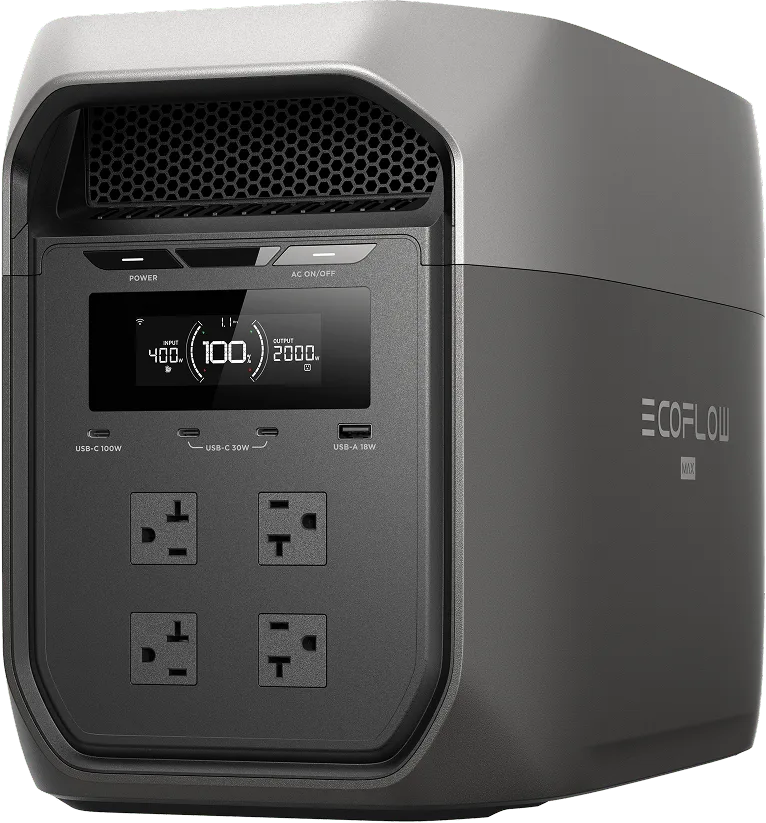
Keeping the refrigerator running is the number-one reason people buy a power station for outages. The good news: a modern fridge uses far less power than most people think, because its compressor cycles on and off instead of running all the time.
Here's how to work out how long any power station will run your refrigerator, using the label already on your fridge and three steps of simple math. No guesswork and no marketing numbers.
Step 1: Find your fridge's average watts
The best number to use is on the yellow EnergyGuide label that comes with every new refrigerator sold in the US. It shows the model's estimated yearly electricity use in kWh, measured with a standard test procedure. If you've lost the label, search your model number plus "EnergyGuide"; manufacturers publish them as PDFs.
Convert yearly kWh into average watts:
Average watts = yearly kWh × 1,000 ÷ 8,760 hours
For example, the Department of Energy's Building America Solution Center shows a refrigerator EnergyGuide label estimating 630 kWh per year, about 1.7 kWh per day. That's 630 × 1,000 ÷ 8,760 ≈ 72 W on average.
Why not use the wattage on the nameplate? The DOE notes that nameplate wattage is the maximum the appliance can draw, so using it overestimates real-world use. A fridge's compressor runs in cycles, and the daily average is what drains a battery.
Step 2: Work out the usable capacity
A power station's capacity is listed in watt-hours (Wh). When it powers AC appliances, some energy is lost converting battery DC power to 120 V AC. We use 85% of rated capacity as the usable figure for AC loads, the same factor we use across our site. Your result can be a little better or worse depending on the model and load.
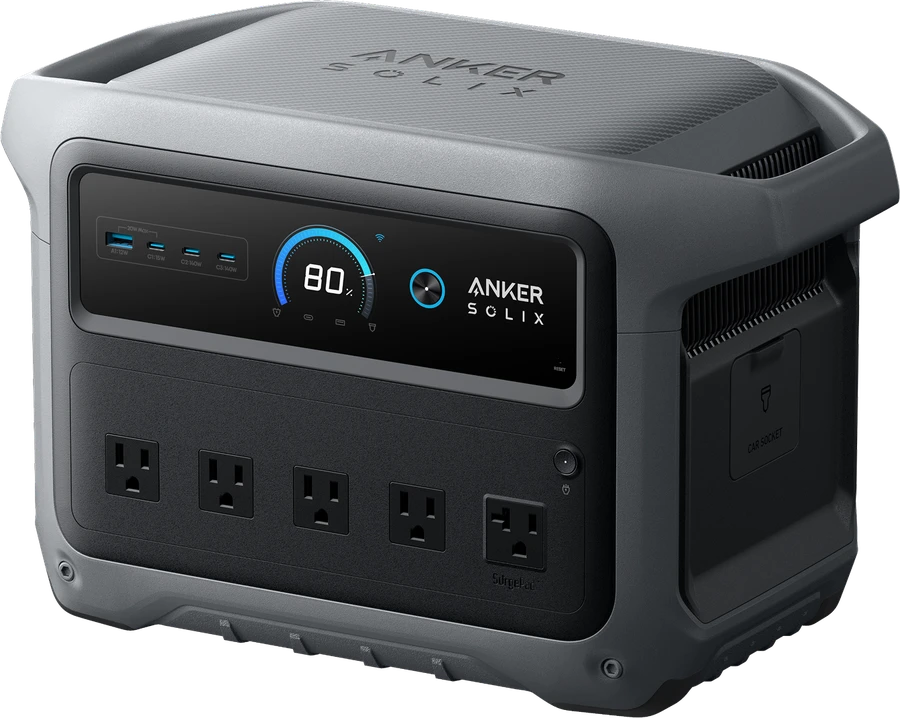
For a 1,024 Wh station such as the Anker SOLIX C1000 Gen 2: 1,024 × 0.85 ≈ 870 Wh usable.
Step 3: Divide, and check the result
Runtime (hours) = usable Wh ÷ average watts
With our 72 W example fridge: 1,024 Wh × 85% ÷ 72 W ≈ 12 hours. If your fridge is older or bigger, use a more conservative figure. At a 150 W average: 1,024 Wh × 85% ÷ 150 W ≈ 5.8 hours.
One more check: the power station's inverter must handle the compressor's startup surge, which is briefly higher than its running watts. Check your fridge's manual or nameplate, and choose a station whose surge rating comfortably exceeds it. Every station in the table below has a continuous rating far above a fridge's running draw.
Runtime table: popular power stations
Estimated hours for a fridge averaging 72 W (an efficient modern model) and 150 W (older or larger fridges). Capacities are the manufacturers' published figures.
| Power station | Capacity | 72 W fridge | 150 W fridge |
|---|---|---|---|
| BLUETTI Elite 30 V2 | 288 Wh | about 3.4 hours | about 1.6 hours |
| EcoFlow RIVER 3 Plus + EB300 | 572 Wh | about 6.8 hours | about 3.2 hours |
| Anker SOLIX C1000 Gen 2 | 1,024 Wh | about 12 hours | about 5.8 hours |
| BLUETTI AC180 | 1,152 Wh | about 14 hours | about 6.5 hours |
| EcoFlow DELTA 3 Max | 2,048 Wh | about 24 hours | about 12 hours |
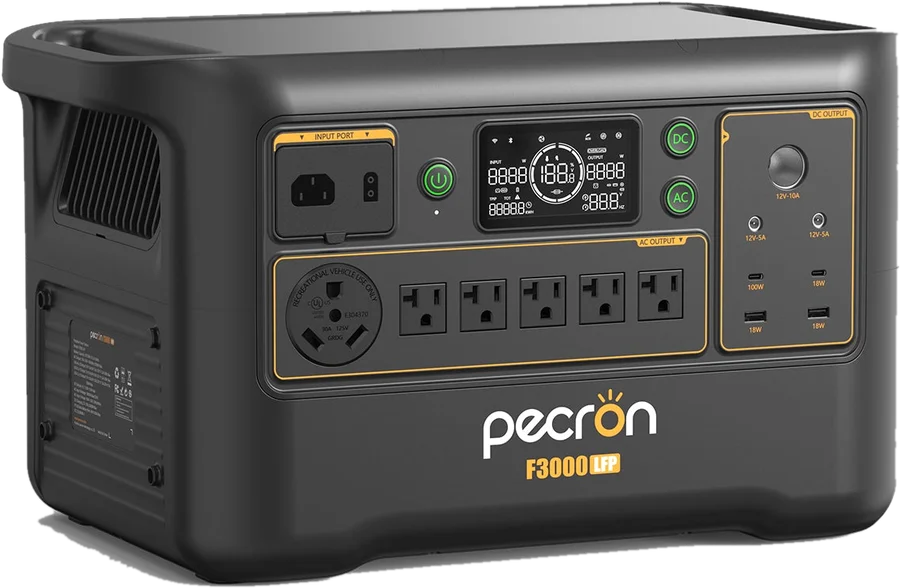
| PECRON F3000LFP | 3,072 Wh | about 36 hours | about 17 hours |
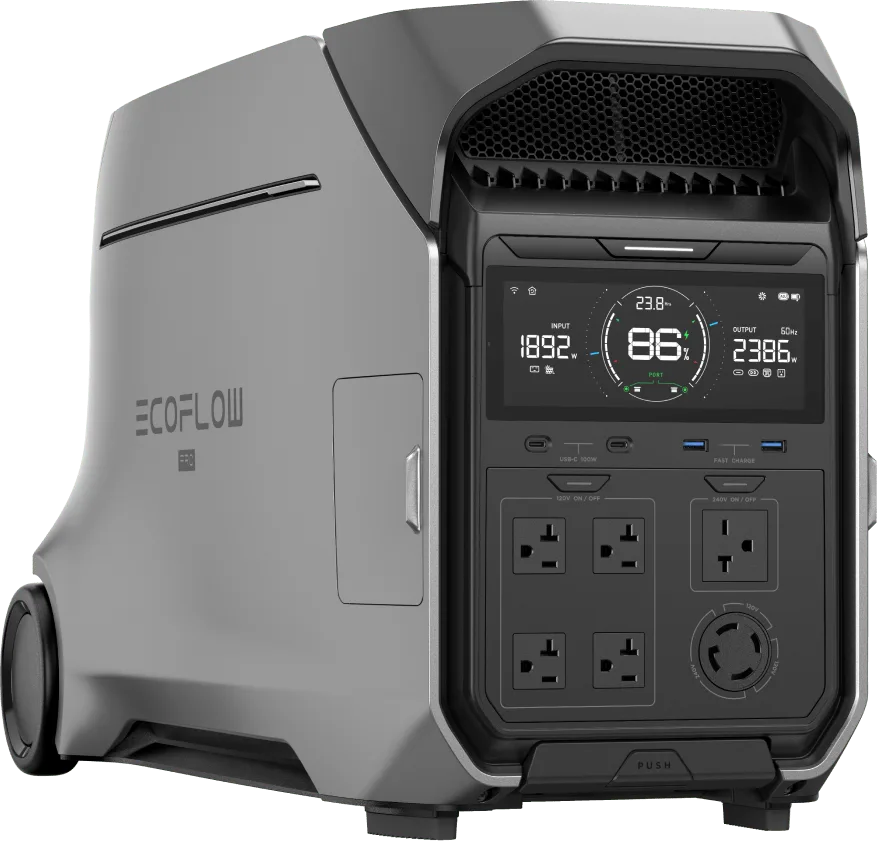
| EcoFlow DELTA Pro 3 | 4,096 Wh | about 48 hours | about 23 hours |
Estimates use capacity × 85% ÷ average watts. Real runtime depends on room temperature, how often the door opens and how full the fridge is.
How to make the battery last longer
- Keep the door shut. Ready.gov notes that a refrigerator keeps food cold for about four hours without power, and a full freezer holds its temperature for about 48 hours. Every opening shortens that.
- Run it in cycles if the outage is long. Because a closed fridge stays cold for hours, you can power it for a few hours, unplug it for a few hours, and stretch a battery much further. Use a fridge thermometer and keep food at 40°F or below. Ready.gov advises discarding perishable food that has been above 40°F for two hours or more.
- Recharge with solar during the day. A station that accepts high solar input can top up while it powers the fridge. Check each model's maximum solar input in our reviews.
- Turn off what you don't need. Ice makers and door heaters (anti-sweat settings) add load.
Mini fridges, chest freezers and 12V fridges
The same three steps work for any appliance that cycles on and off. Compact refrigerators and freezers sold in the US also carry EnergyGuide labels, so start with the yearly kWh figure and convert it to average watts.
Portable 12V compressor fridges, popular for camping and RVs, don't have EnergyGuide labels. Look for the average consumption on the manufacturer's spec sheet instead; it's usually far lower than a household fridge. If yours averages 35 W, a 1,024 Wh station would run it for about 25 hours on AC power, and a little longer from the 12V outlet because you skip the inverter losses.
A chest freezer is often the easiest appliance to keep going: it's well insulated and holds cold for a long time when the lid stays shut, which makes the cycling trick below especially effective.
Common mistakes when sizing a power station for a fridge
- Using the nameplate wattage. It's the maximum draw, not the average. It can make a fridge look several times hungrier than it really is.
- Forgetting inverter losses. Dividing full capacity by watts gives an optimistic answer. Use 85% of capacity for AC appliances.
- Ignoring the startup surge. A small station may have enough energy but not enough surge capacity to start the compressor.
- Testing in the wrong conditions. A fridge works harder in a hot kitchen or when it's opened often, so leave a margin, especially in summer outages.
- Counting on ideal solar numbers. Brands quote solar recharge times in strong sun. Clouds, short winter days and panel angle all slow it down.
What size power station do you need for a fridge?
- Overnight (about 12 hours): a 1 kWh-class station such as the Anker SOLIX C1000 Gen 2 or the BLUETTI AC180 covers an efficient fridge.
- A full day or more: look at 2 kWh and up, such as the EcoFlow DELTA 3 Max (2,048 Wh) or the PECRON F3000LFP (3,072 Wh).
- Multi-day outages: pair a large station with solar panels, or choose an expandable system such as the EcoFlow DELTA Pro 3.
Want to test other appliances? Our comparator estimates runtime for common devices on any station we list.
Frequently asked questions
How many watts does a refrigerator use?
Check its EnergyGuide label. Multiply the yearly kWh by 1,000 and divide by 8,760 to get the average watts. A fridge labeled 630 kWh per year averages about 72 W, even though its compressor draws more while it is running.
Will a 1,000Wh power station run a fridge overnight?
Usually yes. A 1,024 Wh station runs a 72 W average fridge for about 12 hours, or for about 5.8 hours if the fridge averages 150 W.
Can a power station run a fridge and a freezer together?
Yes, if its inverter can handle both startup surges and you add both average wattages together before dividing. Expect roughly half the runtime of one appliance.
How long does food stay safe in a fridge without power?
Ready.gov says about four hours if the door stays closed, and about 48 hours for a full freezer. Throw out perishable food that has been above 40°F for two hours or more.
Products in this article
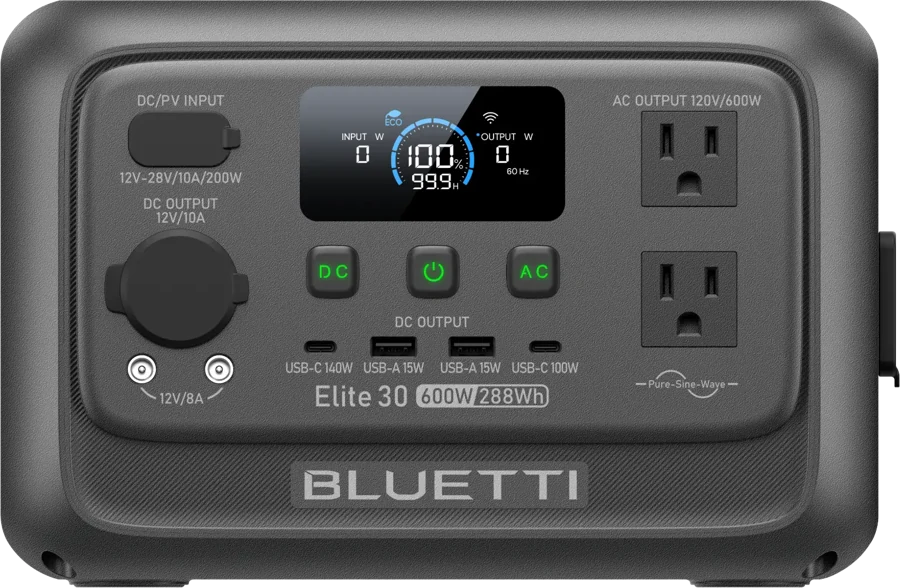
BLUETTI
BLUETTI Elite 30 V2
The pocket-sized LiFePO4 pick with a real 600W inverter
- 288 WhCapacity
- 600 WAC output
- LiFePO4Battery
- 9.48 lbWeight
$289.99reference price*
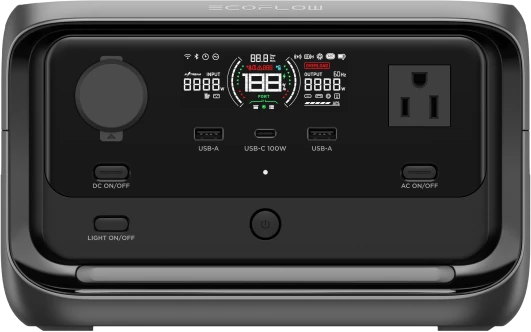
EcoFlow
EcoFlow RIVER 3 Plus + EB300
A quiet, fast-switching UPS for your desk that doubles as a camping battery
- 572 WhCapacity
- 600 WAC output
- LiFePO4Battery
- 18.1 lbWeight
Check Amazon
Anker
Anker SOLIX C1000 Gen 2
The fastest-charging 1kWh station, with a 2,000W inverter
- 1,024 WhCapacity
- 2,000 WAC output
- LiFePO4Battery
- 24.9 lbWeight
$699.99reference price*
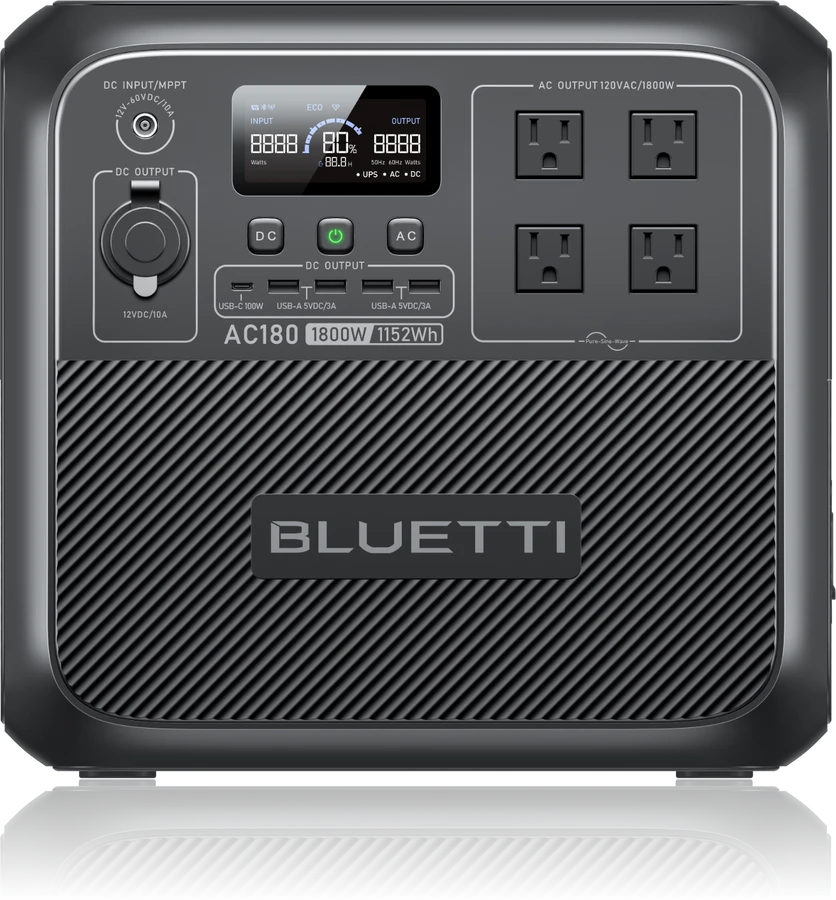
BLUETTI
BLUETTI AC180
A proven 1.1kWh all-rounder at a mid-range price
- 1,152 WhCapacity
- 1,800 WAC output
- LiFePO4Battery
- 35.3 lbWeight
$499.00reference price*
EcoFlow
EcoFlow DELTA 3 Max
2kWh of LiFePO4 with a 10 ms UPS at a 1kWh-class price
- 2,048 WhCapacity
- 2,400 WAC output
- LiFePO4Battery
- 44.8 lbWeight
$879.00reference price*
PECRON
PECRON F3000LFP
3kWh and 3,600W for well under $1,000
- 3,072 WhCapacity
- 3,600 WAC output
- LiFePO4Battery
- 63.3 lbWeight
$899.00reference price*
EcoFlow
EcoFlow DELTA Pro 3
A 240V, 4kWh home battery on wheels
- 4,096 WhCapacity
- 4,000 WAC output
- LiFePO4Battery
- 113.5 lbWeight
$2,799.00reference price*
Sources
- Building America Solution Center (DOE / PNNL): refrigerator EnergyGuide label example
- U.S. Department of Energy: Estimating Appliance and Home Electronic Energy Use
- Ready.gov: Power Outages
Product specs come from each manufacturer's official spec sheet, linked on our review pages. Runtime estimates use our published method: capacity × 85% ÷ device watts (how we calculate).
Keep reading
 Head-to-head · Nov 13, 2026
Anker SOLIX C1000 Gen 2 vs BLUETTI AC180: Which 1kWh Power Station Should You Buy?
Anker SOLIX C1000 Gen 2 vs BLUETTI AC180: capacity, output, charge speed, solar, weight and value compared spec by spec, plus which one to buy.
Read article
Seasonal · Nov 13, 2026
Winter Power Outage Prep: How to Use a Portable Power Station Safely
Get ready for winter storm outages with a portable power station: what it can run, cold-weather charging limits, safety rules and what size to buy.
Read article